Equipment
Keller telescope
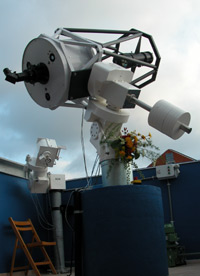
Inaugurated on 21 May 2004, the new Keller telescope reinforces the attractivity of the Observatory through its exceptional performance.
It is a Cassegrain type telescope, equipped with a 50 cm diameter mirror for a focal distance of 5000 mm. It is fixed on a fully computer-driven German mounting. The telescope offers staggering images of deep space objects.
C14 telescope
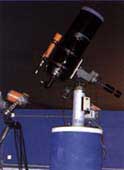
The Observatory is also equipped with a more modern and more powerful instrument - a Celestron 14. It is a telescope which works with mirrors, as is generally the case with performant instruments. This one is a Schmidt-Cassegrain - that is, it has a hyperbolic and concave secondary mirror in the same axis as the primary mirror, which reflects light back through a hole pierced in the primary mirror itself. The image can then be observed through an eyepiece at the end of the tube. This instrument, with a primary mirror of 40cm diameter can capture about 1800 times more light than the naked eye; the diameter of the eyes' pupil is only 5mm!
In order to increase the stability of the instrument we have opted for a German mount. The electronic pilot automatically follows observed objects by compensating for the rotation of the Earth. Our NGC-Max guiding system contains the coordinates of thousands of objects and greatly helps with the aiming of the telescope.
Reinfelder & Hertel telescope
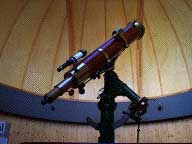
The invention of the telescope in 1608 and the subsequent improvements in optics led to the revolutionary progress of the 17th and 18th centuries. We call this type of telescope a refractor because it deviates the light coming from an object in such a way that its image is reversed; observation is done through an eyepiece at the end of the tube, which allows magnification of the image. Bequeathed by Mr. Robert A. Naef, the Observatories precious telescope is a Reinfelder & Hertel with a diameter of 162.5 mm and a focal distance of 1435 mm - this allows a magnification of X150.
Coelostat
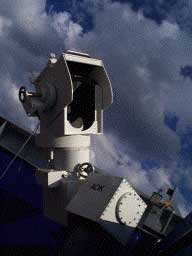
The design and assembly of the coelostat VTT 120 extends the equipment of the observatory to another area. This makes it possible not only to admire the night sky, but also the sun, with its sunspots, prominences, etc. The installation of the telescope opens to visitors several new possibilities:
- Projection of white sunlight against a wall, so that all observers can simultaneously observe sunspots, granulation, solar rotation, etc.
- Projection of the solar spectrum with the Fraunhofer lines
- Observation of prominences by means of a hydrogen-alpha filter
- Observing the Sun in white light directly in the eyepiece with maximum magnification
- Photography and video works
Designer: AOK (Astrooptik Kohler)
Planetarium
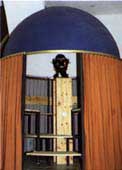
A mini plantarium, with seating for a dozen people, is used for initiating the general public into celestial mechanics: explanations as to the motion of stars and planets, the location of constellations etc. are readily visualized.
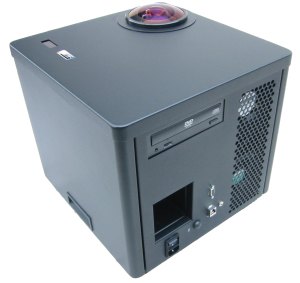
Since March 2006, a new digital planetarium system has been installed: the Digitarium Alpha. This equipment comprises a computer on which an adapted version of the Stellarium open source software runs, and a beamer equipped with a fish-eye lens
A simulated projection of the skies together with a drawing of the constellations and astronomical pictures or movies is made possible thanks to the incorporated DVD drive.